








What you'll learn
- Why traffic isn't the problem (and what is)
- The conversion gap most small business websites have
- 5 changes that convert visitors into customers
- Real results from businesses that fixed conversion without adding traffic
- How to measure whether your website is actually converting
You convert website visitors into customers by giving them something to do, not just something to look at. That means interactive pricing, smart lead qualification, and automated quoting built into your website so visitors can configure what they need, see what it costs, and take the next step without waiting for you to respond.
Most small business websites lose visitors at the same point: the gap between interest and action. Someone lands on your site, likes what they see, but the only option is a generic contact form or a phone number. That's not a conversion path. It's a dead end. The businesses that convert website traffic into sales close that gap by making the website do the selling, not just the showing.
This guide covers why your current website isn't converting, the specific changes that turn browsers into buyers, and real examples from businesses that increased revenue from the same traffic.
Why Your Website Gets Traffic But Doesn't Convert
If your website gets visitors but doesn't generate leads or sales, the problem isn't visibility. It's conversion. You've already solved the hard part: getting people to show up. The easy part should be helping them take action. But most websites make this the hardest step.
Here's the typical pattern. A visitor finds your site through Google, social media, or a referral. They browse your services. They look at your portfolio or past projects. They think, "This looks good." Then they hit a wall. The only next step is "Contact us" or "Request a quote." Both require effort with no immediate payoff. So they leave. They might come back. They probably won't.
The gap between "this looks interesting" and "I'm ready to commit" is where most websites lose people. Closing that gap doesn't require more traffic. It requires a better experience for the traffic you already have. (If you're not sure why your website isn't converting at all, start with our guide on why your website isn't generating leads.)
The Real Reason Visitors Don't Become Customers
It's not your design. It's not your copy. It's that your website asks visitors to do something unnatural: go from browsing to committing in a single step.
Think about how you buy things. You research, you compare, you look at options, you check pricing. Then, when you feel informed and confident, you take action. Your website visitors are doing the same thing. But most small business websites skip the entire middle of that journey. They show what you do and then immediately ask for contact details. There's no pricing. No way to explore options. No way to self-qualify. No way to understand what they'd actually get.
That missing middle is why visitors don't convert. They're not uninterested. They're uninformed. And uninformed visitors don't fill out contact forms. They leave.
5 Ways to Convert More Website Visitors Into Customers
Each of these changes addresses a specific part of the conversion gap. You don't need all five to see results, but the more you implement, the bigger the impact.
1. Put Pricing on Your Website
This is the single highest-impact change for most service businesses. Visitors want to know what things cost. If your website doesn't tell them (or at least give a useful range), they leave and find a competitor who will.
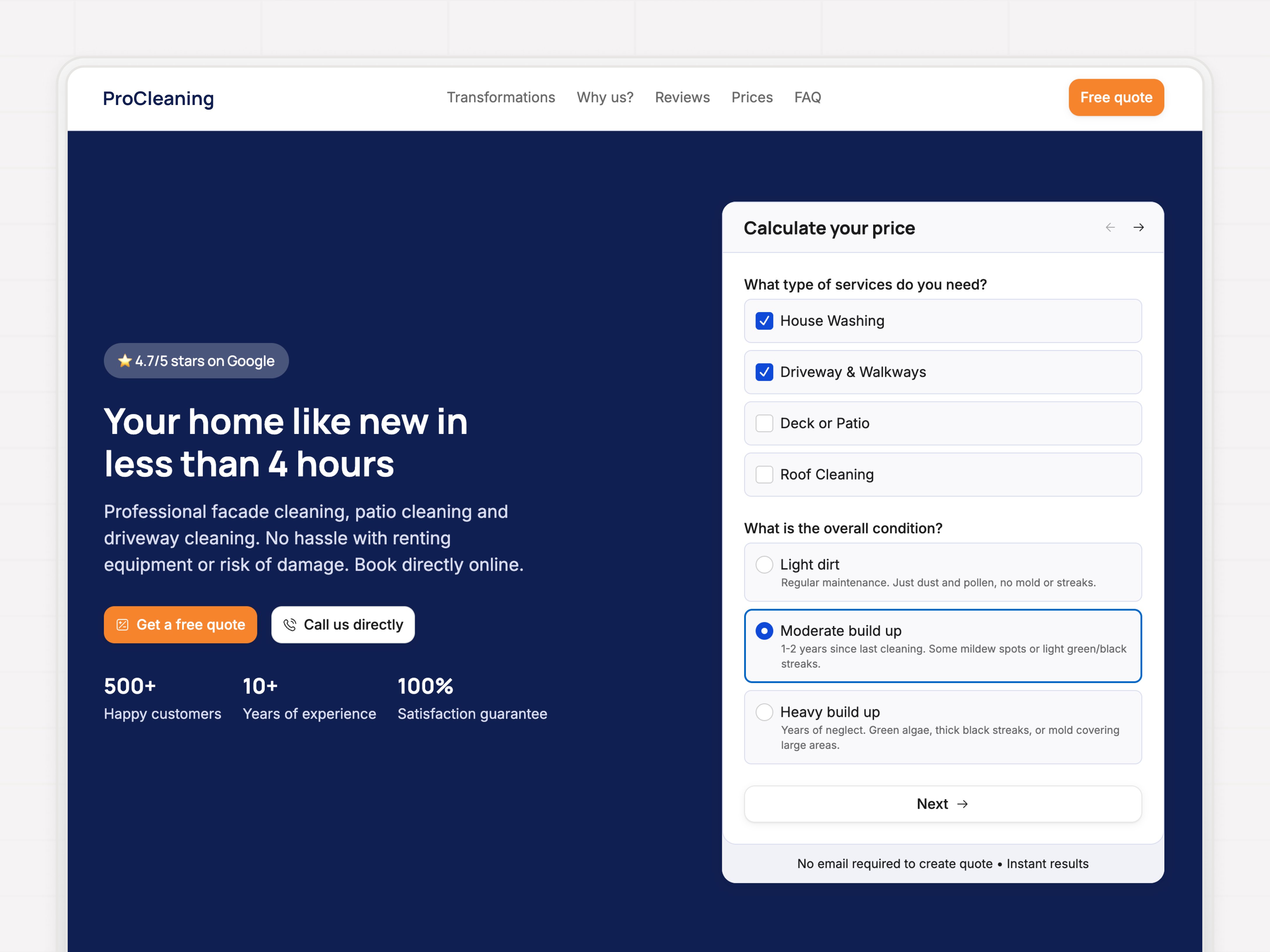
An interactive pricing configurator lets visitors choose their options and see a price instantly. They're not committing to anything. They're exploring. But that exploration builds investment, understanding, and trust. By the time they do contact you, they already know the ballpark. They're serious.
For businesses with complex pricing (zones, tiers, add-ons, seasonal rates), this is even more powerful. The pricing logic that lives in your head gets encoded into the website. Every visitor gets a consistent, accurate answer. You stop fielding "How much does this cost?" emails.
2. Let Visitors Configure What They Need
Configuration is the next level beyond pricing. Instead of just showing a number, you let visitors build their own version of what they want. Choose the size, pick the options, select the add-ons, set the date. This does two things. First, it makes the visitor feel like they're designing something for themselves, not just shopping. Second, it captures detailed, structured data about exactly what they need.
When someone submits a configured request, you don't get a vague "I'm interested" email. You get "I want a 3-bed, 2-bath job in Zone B with underfloor heating and a smart thermostat. Total: £12,400." That's a customer, not a browser.
3. Qualify Leads Before They Reach Your Inbox
Not every visitor is a good fit. Some don't have the budget. Some need something you don't offer. Some are just browsing with no intention to buy. A smart qualification flow asks the right questions early: budget range, timeline, location, project type. Visitors who don't match your criteria get a polite redirect. Visitors who do match arrive in your inbox with everything you need to close them.
This isn't about being exclusive. It's about spending your time on the people most likely to buy. Every hour you spend on an unqualified lead is an hour you're not spending on a qualified one.
4. Automate Quoting So Speed Wins the Deal
Speed matters more than most businesses realise. The first company to respond to an enquiry wins the business 35-50% of the time. If your quoting process takes 24-48 hours because you're manually calculating prices and writing proposals, you're losing deals to faster competitors.
Automated quoting turns visitor inputs into a structured quote instantly. No manual calculation. No spreadsheet. No delay. The visitor configures what they need, gets a quote, and can move to the next step immediately. You review and approve rather than build from scratch. (For a full walkthrough, see how to add a quote calculator to your website.)
5. Make Your Website Work After Hours
Your best leads don't arrive at 10am on a Tuesday. They arrive at 9pm on a Sunday, during a bank holiday, or while you're on a job site with your phone off. If your website relies on someone being available to respond, you're losing the leads that come in outside business hours.
A website that handles pricing, configuration, qualification, and quoting automatically doesn't need you to be online. It converts visitors into customers at 3am the same way it does at 3pm. That alone can transform your conversion rate without a single extra visitor.
The Maths: Why Conversion Beats Traffic Every Time
Most founders default to "get more traffic" when revenue is flat. It's intuitive: more visitors should mean more sales. But the numbers tell a different story.
| Double traffic | Double conversion rate | |
|---|---|---|
| Monthly visitors | 2,000 → 4,000 | 2,000 (unchanged) |
| Conversion rate | 1% (unchanged) | 1% → 2% |
| Leads per month | 40 | 40 |
| Cost to achieve | £500-2,000+/month in ads | One-time setup, no ongoing ad cost |
| Lead quality | Same (unqualified mix) | Higher (visitors self-qualify) |
| Compounds over time | No. Stop paying, traffic stops | Yes. Better system keeps converting |
Both approaches produce the same number of leads. But the traffic route costs money every month, delivers the same quality leads, and stops the moment you stop paying. The conversion route costs once, improves lead quality, and compounds as you refine the system.
This is why Outback Plunge Pools grew 50%+ year on year without increasing ad spend. They didn't buy more visitors. They made each visitor worth more. That's a fundamentally different growth model, and it's available to any business willing to fix the website instead of throwing money at traffic.
Real Results: Converting More Visitors Without More Traffic
These businesses didn't buy more ads or invest in SEO campaigns. They changed how their website worked. The traffic stayed the same. The results didn't.
Outback Plunge Pools: 50%+ Year-on-Year Growth, Same Traffic
50%+ year-on-year revenue growth Outback Plunge Pools, custom plunge pool installation
Outback Plunge Pools replaced phone consultations with an online pool configurator. Visitors choose size, depth, materials, heating, and installation zone, then see the price and submit a detailed enquiry. The same website traffic that used to generate a handful of phone calls now generates qualified, specification-complete leads. Revenue grew over 50% year on year without increasing ad spend.
JSJ Smart Homes: 97% Reduction in Quoting Costs
97% reduction in quoting costs JSJ Smart Homes, smart home installation and automation
JSJ Smart Homes moved their quoting process online. Visitors configure their smart home setup (rooms, devices, integrations), see pricing, and submit a complete specification. The founder went from spending hours per quote to reviewing and approving pre-built quotes in minutes. The conversion improvement came from removing friction, not adding traffic.
Goodhart Coffee: 40+ Hours Per Week Freed Up
40+ hours/week saved Goodhart Coffee, mobile coffee catering for events
Goodhart Coffee replaced manual event quoting with an online configuration tool. Visitors choose guest count, service duration, location, and add-ons, then see pricing and book directly. The founder reclaimed over 40 hours per week. More importantly, the conversion rate improved because visitors could see pricing and commit without waiting for a manual response.
Rift Photography: Leads Captured Around the Clock
Leads captured 24/7, even during shoots Rift Photography, wedding and event photography
Rift Photography was losing leads because the founder couldn't answer enquiries while on shoots. After building a system where visitors choose packages, see pricing, and book directly, leads stopped falling through the cracks. The website converts visitors into bookings whether the founder is available or not.
How to Measure Whether Your Website Is Converting
You can't fix what you don't measure. Here are the numbers that matter for converting website visitors into customers.
| Metric | What it tells you | Healthy benchmark |
|---|---|---|
| Visitor-to-lead rate | How many visitors take a meaningful action | 2-5% for service businesses |
| Lead-to-customer rate | How many leads become paying customers | 20-40% with qualified leads |
| Time to first response | How quickly a lead gets a price or quote | Under 5 minutes (automated) is ideal |
| Form completion rate | How many people finish your intake flow | 40-60% for well-designed flows |
| Revenue per visitor | Total revenue divided by total visitors | Track monthly; focus on trend, not absolute |
The most important number is revenue per visitor. If that number is going up without traffic increasing, your website is converting better. Everything else is a diagnostic tool to figure out where the leaks are.
Stop Buying Traffic. Start Converting It.
The most expensive way to grow your business is to keep buying more traffic to a website that doesn't convert. Every visitor who leaves without taking action is money you've already spent, wasted.
Converting website visitors into customers isn't about clever copy or better design. It's about giving visitors a reason to stay and a mechanism to act. Show them what things cost. Let them configure what they need. Qualify them before they reach your inbox. Quote them instantly. Work while you sleep.
The businesses in this guide grew revenue from the same traffic. No extra ad spend. No SEO overhaul. They turned their website from something people look at into something that makes money.
Your website has enough visitors. The question is whether it's doing anything with them.
Not getting traffic in the first place? Check whether your website is actually showing up on Google. Some platforms make your site invisible to search engines without you knowing.
Calculate additional revenue your website could make
FAQ
Frequently asked questions answered







Use cases
