7 Signs Your Website Is Lazy (And Costing You Leads)







Your website looks fine. Professional design, decent copy, clear navigation. But looking good and doing work are different things.
A lazy website sits there while you handle every quote, answer every pricing question, and manually qualify every lead. A working website does that for you. The difference costs founders 10-40 hours per week in busywork, and an unknown number of leads who left because they couldn't get answers fast enough.
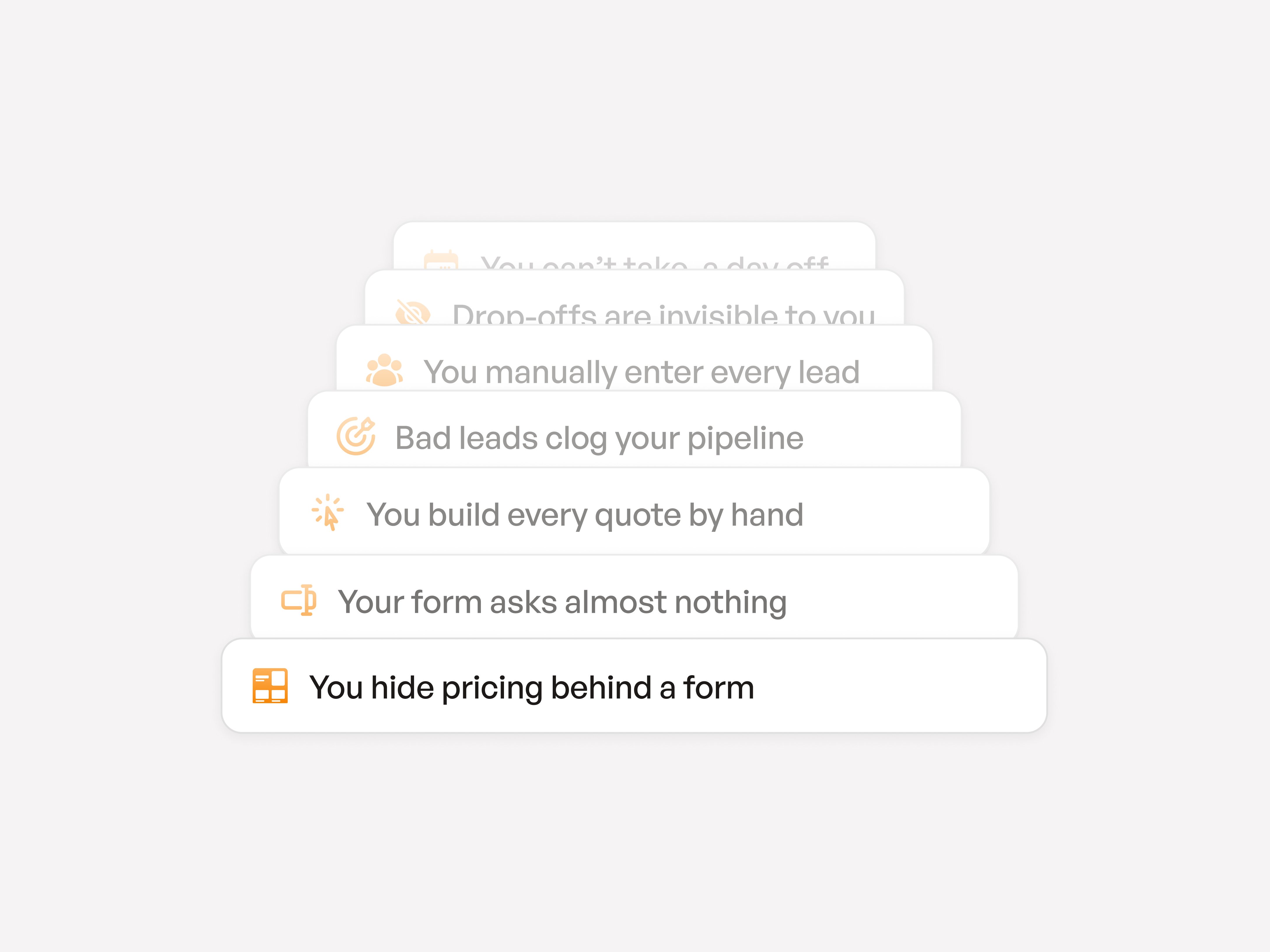
Here are seven signs your website is lazy. Each one represents time you're losing and leads you're leaking. The more signs you recognize, the more your website is costing you.
If the answer to 'what does this cost?' is 'fill out this form and we'll get back to you,' your website is lazy.
Modern buyers research before they reach out. According to Gartner, B2B buyers spend only 17% of their purchase journey meeting with potential suppliers. The rest happens independently—online, comparing options, understanding pricing. If your website can't answer pricing questions, visitors leave and find someone whose site can.
This doesn't mean you need fixed pricing. Businesses with variable, complex, or configurable pricing can still show visitors what things cost. A pool installation company can let visitors configure pool type, size, and features to see an estimate. A smart home integrator can walk visitors through system options and show pricing tiers. The visitor gets an answer. You get a qualified lead who already understands your price range.
The cost of laziness: Every visitor who wants pricing but can't get it either leaves immediately or submits a vague inquiry that wastes your time. Either way, you lose.
A contact form that asks for name, email, and 'how can we help you?' is doing the bare minimum. It's a lazy form on a lazy website.
Think about what you actually need to quote a job or qualify a lead. For a pressure washing company: property type, square footage, surfaces to clean, timeline. For a photography business: event type, date, location, number of hours. For a solar installer: roof type, monthly energy bill, shading conditions. None of that gets captured in a name-and-email form.
The result: you get an inquiry, then send an email asking for details, then wait for a response, then send another email with more questions. Three to five days pass before you can even start a quote. Meanwhile, the visitor contacted three other companies whose sites asked the right questions upfront.
The cost of laziness: Extended quote cycles, lost deals to faster competitors, and hours spent in email ping-pong gathering information your website should have captured.
If you're building quotes from scratch in Word, Excel, or a PDF template, your website is lazy. It collected the lead but left all the work to you.
Manual quoting is one of the biggest time sinks for service businesses. A smart home integrator reported spending 3-7 days on each custom quote before automating the process. A coffee catering company spent 40+ hours per week on quote creation and follow-up. That's not sales work—that's administrative work your website could eliminate.
A working website generates quotes automatically. Visitor configures options, system calculates pricing based on your rules, quote appears instantly or lands in your inbox ready to send. The visitor gets an answer in minutes. You get hours back every week.
The cost of laziness: One company documented a 97% reduction in quoting costs after automating. If you're still doing it manually, you're paying that cost in time every single week.
Every lead feels urgent when it arrives. But if your sales team spends hours educating and quoting for people who were never going to buy, your website failed at its job.
A lazy website treats every visitor the same. Someone researching for a project two years away gets the same experience as someone ready to buy this month. A tire-kicker gathering information for a competitor submits the same form as a serious buyer. You can't tell them apart until you've invested time.
A working website qualifies leads before they reach you. Smart questions filter by timeline, budget, project scope, and fit. Visitors who don't match your criteria either self-select out or get routed differently. Your inbox fills with 'red hot' leads—people who've seen pricing, understand what's involved, and are ready to move forward.
The cost of laziness: Hours per week spent on leads that go nowhere. Frustration and burnout from chasing fact-finders. Missed opportunities because serious buyers got buried in the noise.
When a lead comes in, where does the information go? If the answer involves copying from an email and pasting into your CRM, calendar, or spreadsheet, your website is lazy.
Manual data entry creates three problems. First, it takes time—multiplied by every lead you receive. Second, it introduces errors. Wrong addresses, misspelled names, incorrect project details. Third, it delays action. The lead sits in your inbox until someone processes it.
A working website pushes structured data directly into your systems. Lead submits a request, and within seconds it appears in your CRM with all fields populated. If relevant, it creates a calendar event, triggers an email sequence, or routes to the right team member. No manual steps. No transcription errors. No delays.
The cost of laziness: Time lost to data entry, mistakes that damage customer relationships, and slower response times that cost deals.
How many visitors start your contact form but don't finish? What questions cause people to abandon? Which service pages get traffic but zero inquiries? If you don't know, your website is lazy—and you're flying blind.
Basic analytics tell you page views and bounce rates. That's not enough. You need to know what visitors are configuring, where they hesitate, and what makes them leave. Is the price too high? Is a required question confusing? Are people looking for something you don't offer?
A working website gives you visibility into the entire funnel. You see which options people select most often. You identify questions that cause drop-offs. You learn what your market actually wants—not what you assume they want. Then you improve the flow and convert more visitors.
The cost of laziness: Missed optimization opportunities, wasted marketing spend driving traffic to broken flows, and competitors who figure this out before you do.
This is the emotional sign. If you feel anxiety about missing leads when you're at a job site, on a photo shoot, or trying to take a weekend off, your website is lazy.
A lazy website creates dependency. Every inquiry needs you. Every quote needs you. Every follow-up needs you. You become the bottleneck, and the business can't run without your constant attention. Growth feels impossible because it means more chaos, more admin, more time trapped at your desk.
A working website creates freedom. Leads come in qualified and informed. Quotes generate automatically. Data routes to the right places. You can turn off your phone on a hike, finish a client project without interruption, or take an actual vacation—and nothing breaks.
One photographer described it this way: 'I used to panic if I couldn't check my phone during shoots. Now my website handles leads while I'm doing the work I actually love.'
The cost of laziness: Burnout, stress, no work-life separation, and the feeling that your business owns you instead of the other way around.
| Sign | Lazy Website | Working Website |
|---|---|---|
| Pricing visibility | "Contact us for a quote" | Configure options, see pricing instantly |
| Lead capture | Name + email + message box | Structured flow with specs and requirements |
| Quote creation | Manual, 1-7 days | Automatic, instant |
| Lead quality | Everyone hits your inbox | Only qualified leads reach you |
| Data handling | Copy-paste into CRM | Auto-routes to systems |
| Analytics | Page views only | Full funnel visibility |
| Founder freedom | Always on call | Business runs without you |
You just read seven signs of a lazy website. How many apply to yours?
1-2 signs: You're ahead of most businesses, but there's room to improve. Focus on the biggest time sink first.
3-4 signs: Your website is underperforming. You're likely losing 10-20 hours per week to work your website could handle.
5-7 signs: Your website is actively costing you money. Every week you wait is more time lost and more leads leaked.
The fix isn't a website redesign. Pretty doesn't solve lazy. The fix is building a website that actually does the work—configuration, pricing, quoting, qualification, and data routing. A website that earns its keep instead of just sitting there.
Start by fixing the sign that costs you the most time. For most founders, that's manual quoting or unqualified leads. Solve that one problem, see the results, then tackle the next.
Your website should be your hardest-working employee. If it's not pulling its weight, now you know what to fix.