








What you'll learn
- Why does solar lead quality matter more than quantity?
- How do you define your solar lead criteria?
- How do you research and compare solar lead providers?
- Reputable solar lead providers to consider:
- What should you ask for when requesting solar lead samples?
Buying solar leads means purchasing contact information for homeowners or businesses that have shown interest in solar panel installation.
Lead providers gather this information through online forms, advertising, and content marketing, then sell it to solar companies for prices ranging from $20 to $200 per lead, depending on quality and exclusivity.
For solar installers and sales teams, purchased leads can be the fastest way to fill a pipeline. But more leads don't always mean more sales. A pile of stale or poorly qualified leads drains your budget, demoralizes your sales team, and stalls your growth.
A smaller list of qualified solar leads (verified homeowners, in your service area, with real interest in solar) can produce a higher return on investment than 10x the volume of low-intent leads.
This guide walks through what to look for when buying solar leads, what to ask providers before purchasing, how to compare cost per lead vs cost per acquisition, and when generating your own leads beats buying outright.
KEY TAKEAWAYS
-
Purchased solar leads cost between $20 and $200 each, depending on exclusivity, quality, and how recent the lead is.
-
Low-cost shared leads sell to multiple solar companies at once. Exclusive solar leads cost more but convert at higher rates.
-
The right metric is not cost per lead, it is cost per acquisition (CPA). A $30 lead that never converts is more expensive than a $100 lead that closes.
-
Qualified solar leads come with verified homeowner status, location matching your service area, and in-market intent (currently considering solar, not just curious).
-
The fastest-growing solar companies pair bought leads with their own lead engine. Eltex went from 0 to 30 qualified solar leads per day after building a custom solar calculator with Convert_.
-
Generating your own leads through SEO, content marketing, and referrals compounds over time. Bought leads do not.
Why does solar lead quality matter more than quantity?
In the solar industry, growth hinges on one thing: high-quality leads. The temptation is to chase volume, more leads, more outreach, more deals. But scaling on weak leads burns cash and morale.
The right solar lead converts. The wrong one wastes hours of your sales team's time on prospects who were never going to buy. Poor-quality leads don't just hurt your conversion rate, they erode confidence, slow down ramp, and push talented reps out the door.
A smaller list of qualified solar leads (verified homeowners, in your service area, with real interest in solar) can produce stronger conversions and meaningful ROI. The lead quality you accept defines the pipeline you build.
How do you define your solar lead criteria?
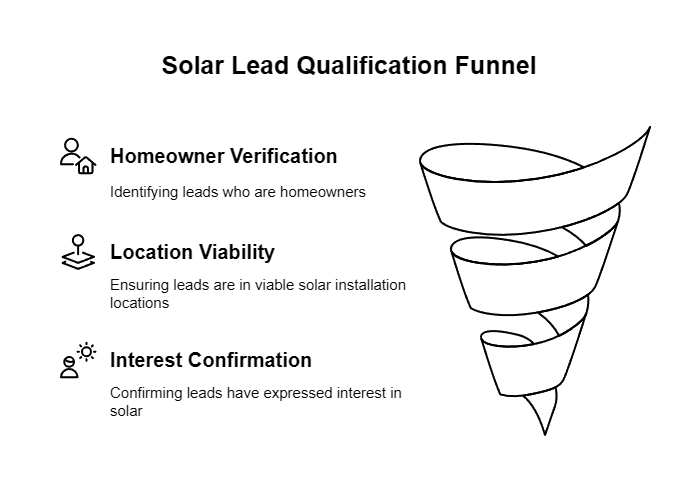
Before you spend a dollar on lead acquisition, define exactly who you want to talk to. Most lead providers ask the same questions, and the more specific you can be, the better your lead match.
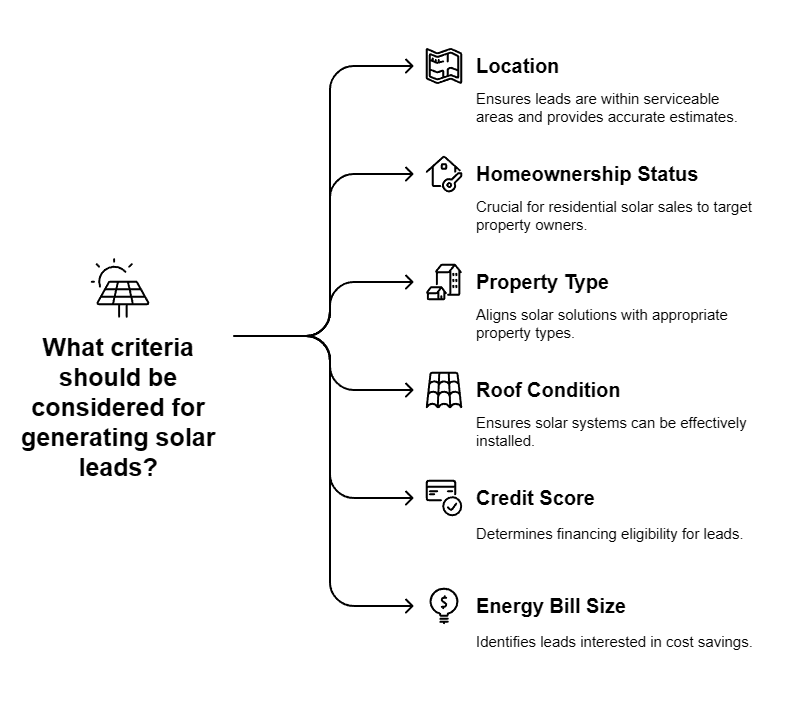
The standard criteria for residential and commercial solar lead targeting:
-
Location and service area. Define the cities, regions, or zip codes you cover. Cross-state leads usually don't convert because the cost of travel kills the economics.
-
Property type and ownership. In the residential solar industry, verified homeownership is the single biggest qualifier. Renters and apartment dwellers can't approve solar panel installation.
-
Demographic filters. Income range, property value, and roof type all affect installation viability. Many lead providers can filter on these.
-
In-market intent. A lead that requested a quote last week is worth ten leads that filled out a generic form six months ago. Ask providers what time window their leads were captured in.
-
Residential vs commercial. The two segments need different sales motions. If you sell both, commercial solar leads usually have longer sales cycles and higher deal sizes.
Get this right and every later step becomes easier. Get it wrong and even the best provider will send you leads you can't close.
To generate your own leads, setup a calculator form on your website that captures the exact lead information you need. Like this customizable solar lead generation funnel template:
Solar Lead Funnel with Google Solar
How do you research and compare solar lead providers?
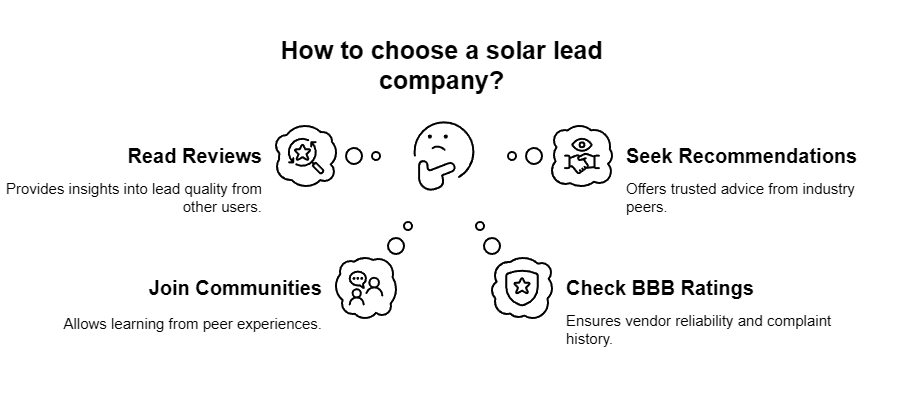
Once your criteria are set, evaluate the providers. The major US solar lead providers include Modernize, Clean Energy Experts, Solar.com, and SolarReviews. Each runs different lead generation channels, including google ads, content sites, comparison platforms, and partnerships with installers.
Things to verify before you spend:
-
Lead source. Where do their leads originate? Search ads, social campaigns, content marketing, or LinkedIn outreach all produce different lead profiles.
-
Pricing model. Are they pay-per-lead, pay-per-appointment, or revenue-share? Pay-per-lead is the most common but the highest variance.
-
Verification process. Do they verify homeowner status, contact information, and intent? Cheap leads tend to be unverified.
-
Refund and replacement policy. Most reputable solar lead providers replace bad leads (wrong number, not a homeowner, not in market) within a defined window. Get the terms in writing.
-
Integrations. Does the provider sync directly with your crm (Salesforce, HubSpot, Pipedrive)? Manual exports kill response time and lose leads.
Build a short list of 2 to 3 providers to trial. Don't commit to one until you've tested at least two with the same criteria.
Reputable solar lead providers to consider:
Each provider has its strengths. For example, Solar Exclusive is known for higher-cost but appointment-ready leads, while Modernize offers volume at a lower cost per lead. Do your due diligence before making a commitment.
What should you ask for when requesting solar lead samples?
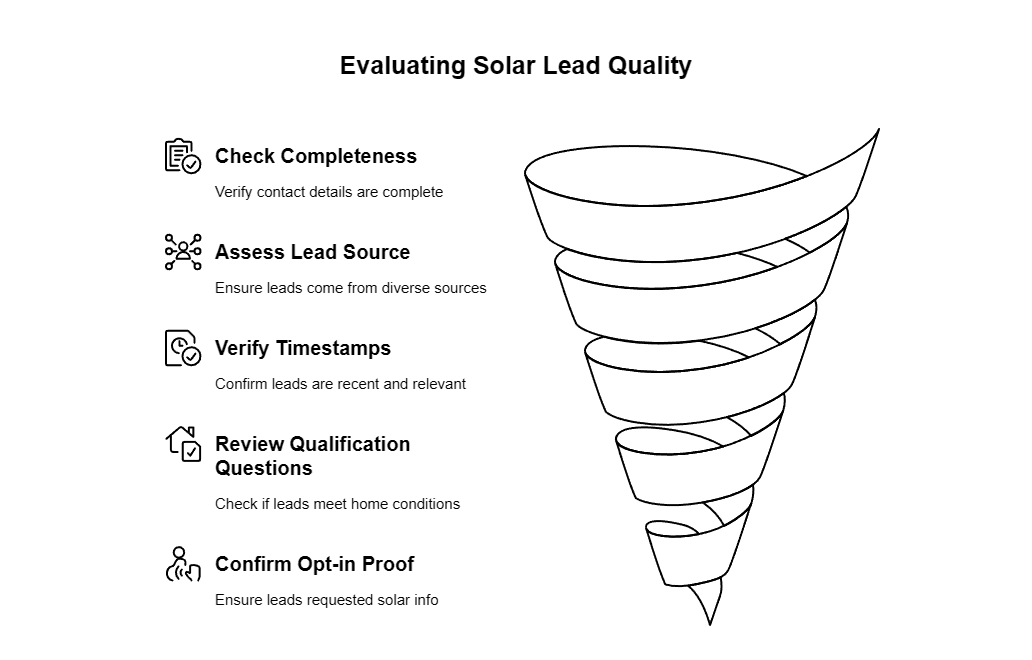
Always request sample leads before you buy in volume. A reputable provider has nothing to hide. A provider that dodges this question is a red flag.
When reviewing samples, check:
-
Recency. Aged solar leads (older than 30 days) convert at a fraction of fresh leads. Ask exactly when each sample lead was captured.
-
Exclusive vs shared. Exclusive solar leads are sold to one buyer only. Shared leads go to multiple solar companies at once, which means the prospect gets called five times in an hour and stops responding. Exclusive leads cost more per lead but convert higher.
-
Intent quality. Did the lead request a quote, or just fill out an informational form? Quote requests are higher intent.
-
Data completeness. Does the lead include phone number, email, address, property type, and energy bill? Incomplete data means more qualification work on your end.
If a provider refuses to share samples or only sends cherry-picked best-case examples, walk away. The provider's confidence in their pay-per-lead pricing should match their confidence in their lead quality.
How do you analyze the real cost of buying solar leads?
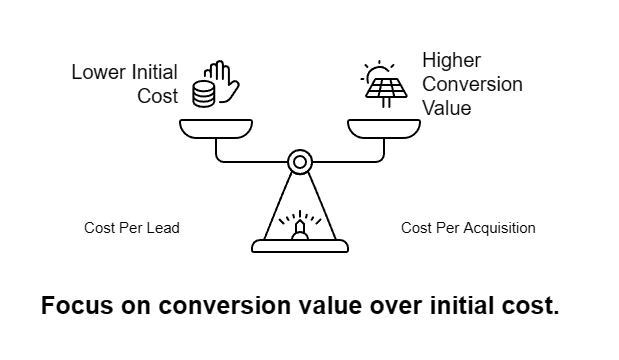
It's tempting to look only at cost per lead (CPL) when evaluating providers. The real metric is cost per acquisition (CPA), the total spend divided by the number of closed deals.
The math:
-
100 leads at $30 each = $3,000 spent
-
If 2% close, that is 2 deals
-
CPA = $1,500 per deal
Compare that to:
-
50 exclusive leads at $80 each = $4,000 spent
-
If 12% close, that is 6 deals
-
CPA = $667 per deal
The "cheaper" leads cost more than 2x the CPA. CPA is what determines whether buying leads is profitable for your solar business.
Other costs to factor in:
-
Sales team time spent qualifying each lead
-
crm setup and data syncing
-
Replacement cost for bad leads (if not covered by the provider)
-
Internal admin overhead
Run the CPA math on a sample batch before committing to a provider's full pricing.
How do you make a purchase and track performance?
Start small. Buy a sample batch of 50 to 100 leads from your top provider and run them through your full sales process. Track every step:
-
Contact rate (how many leads answered)
-
Qualification rate (how many were a fit after talking)
-
Appointment rate (how many booked a consultation)
-
Close rate (how many converted to a sale)
-
CPA (total spend divided by closes)
Compare your numbers against any benchmarks the provider quoted. If they promised a 5% conversion rate and you're getting 1%, that's data you can use to negotiate refunds, switch providers, or restructure your sales process.
Use HubSpot, Salesforce, or whatever crm you already run. Lead source attribution is critical here, you need to know exactly which leads came from which provider to compare them fairly.
What mistakes should solar companies avoid when buying leads?
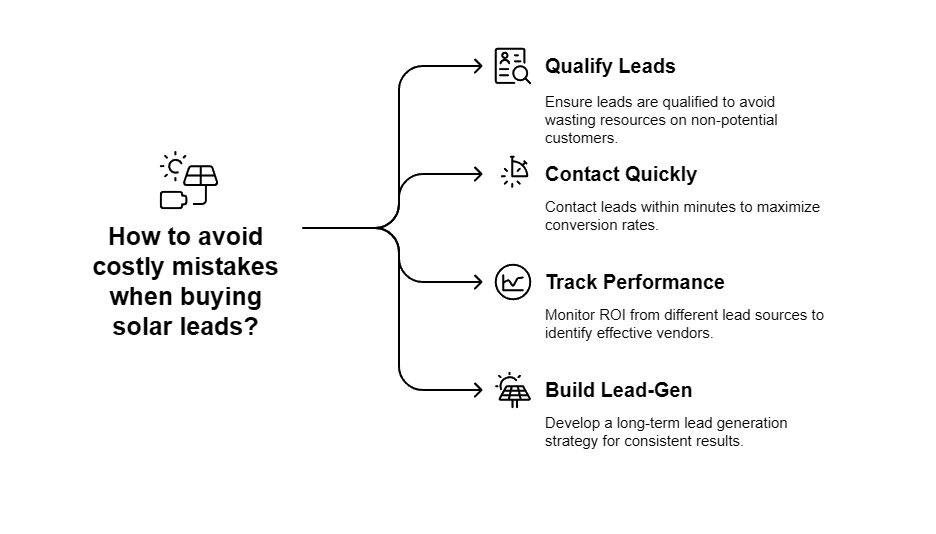
Five mistakes that quietly drain budget:
1. Not vetting solar lead providers. Not every provider is equal. Some sell the same lead to 10 solar companies. Some misrepresent intent. Spend the time to compare.
2. Failing to define criteria upfront. Without clear criteria, providers send you whatever they have. Generic leads kill conversions.
3. Skipping lead qualification on intake. Even verified leads need a quick qualifying call. Otherwise your sales reps burn hours on cold prospects.
4. Ignoring lead aging. Aged solar leads convert at a fraction of fresh leads. Solar interest drops fast, your team needs to be calling new leads within minutes, not days.
5. Relying entirely on bought leads. Buying solar leads is a good tactic, not a long-term strategy. Over time, the most profitable solar companies build their own lead generation engines and use bought leads to fill gaps rather than as their primary source.
How do you generate your own qualified solar leads?
Buying solar leads can work, but it is not the only way, and in most cases it is not the best way. The fastest-growing solar companies generate their own leads using a combination of SEO, content marketing, referrals, and on-site lead capture tools.
SEO drives in-market traffic. Content that ranks for "solar installation [city]," "solar panel cost," and similar queries brings prospects who are already researching. SEO leads convert at higher rates than cold ads because the prospect found you, not the other way around.
Content marketing compounds. A blog post written today can generate leads for years. Content marketing also builds trust before the sales conversation starts. Solar companies that invest in content marketing (cost calculators, savings guides, installation explainers) typically see lead volume scale on its own after 6 to 12 months. Bought leads stop working the day you stop paying.
Referrals are the highest-converting solar lead source. A referral from a happy customer converts at multiples of any cold lead, because trust is pre-built. Set up a simple referral program with a small reward and your existing customers become your best lead source.
On-site lead capture turns visitors into qualified solar leads. A custom solar calculator on your website lets prospects estimate their savings, capture their address, and qualify themselves on the spot. The leads are exclusive (only yours), in-market, and pre-qualified by your custom rules. Convert_ offers solar templates for the most common use cases, including the solar power calculator, the solar savings calculator, the solar loan calculator, and the solar price quote.
Eltex went from 0 to 30 qualified solar leads per day after replacing their static contact form with a Convert_ solar calculator. Read the full Eltex case study for the configuration and timeline.
The combined effect of SEO, content marketing, referrals, and a custom on-site calculator is a lead engine that grows in value over time. That is the opposite of buying leads, where you pay full freight every month and the meter never stops.
Ready to build your own solar lead engine?
Buying solar leads has its place. Generating your own builds a moat. The two work best together: bought leads fill gaps, your own engine compounds.
Book a demo to see how Convert_ handles solar lead capture, custom pricing logic, and crm sync. Or start with a free Convert_ account and adapt one of the solar templates to your business.
Solar Lead Generation Funnel
FAQ
Frequently asked questions answered

Emma Francey
Copywriter @ConvertSite







Use cases
