





Lead generation for digital marketing agencies: turn a clear offer into useful sales conversations






Pira Seligman
Pira Seligman

Lead generation for a digital marketing agency means attracting businesses that could become clients of the agency itself. The work starts with choosing the problem you want to be hired to solve.
“We help businesses grow” gives a prospect little to evaluate. A specific offer lets them understand what you would look at, what you would deliver, and whether their situation fits.
Build the acquisition plan around that offer. Then connect the channel, landing page, first conversation, and follow-up so the prospect does not have to start explaining their business again at every step.
Consider a hypothetical paid-media agency working with local service businesses. It wants clients who already buy traffic but receive too few useful quote requests.
That is a more concrete starting point than targeting every company that wants leads. The agency can review the connection between the campaign promise, landing page, request, and sales response.
Write down the conditions under which the work makes sense. Does the business have an offer people buy? Can it serve additional customers? Is someone responsible for following up? Which parts can your agency influence?
These questions affect the engagement. A new business still testing its service may need different work from an established company with a broken quote journey.
Choose language the prospect recognises. “Find where paid clicks stop becoming quote requests” explains the job more clearly than a list of marketing disciplines.
Choose an entry point that helps them make a decision before a sales conversation.
For the hypothetical agency, that could be a walkthrough showing how an ad promise connects to a service estimate and request. It could also be a short self-assessment that helps an owner identify what their website leaves unanswered.
Make the limits clear. A self-assessment reflects the answers someone provides. It cannot establish what is wrong with their campaigns without access to the relevant evidence.
A useful entry point should lead naturally to work you can deliver. An unrelated giveaway may collect addresses without revealing any need for your service.
If you offer a review, describe the scope and output. A prospect should know what you will examine and what they will receive. Avoid promising that the review will uncover a particular amount of lost revenue.
Search content can address problems prospects already describe. For this agency, articles about quote-request quality or the handoff from ads to a service page would connect to the offer. Include a working example and explain the decisions behind it.
Partnerships can connect the agency with businesses facing the same problem. A web studio might need help after launching a client's site. Agree on which situations deserve an introduction and who owns the next conversation.
Targeted outreach can begin with an observable problem. If an ad offers an estimate and the destination only offers a general contact form, describe that mismatch. Acknowledge what you cannot know without the business's data.
Paid campaigns let you test an offer with an audience, but traffic still needs somewhere useful to go. Keep the campaign promise specific enough to carry through to the page.
Start with a channel you can manage consistently. Add another when you can explain what the current one produces and where the next constraint sits.
The page should help a prospect judge whether your offer fits. Explain the situation you work on, what the engagement includes, and what evidence you would need before recommending changes.
Use relevant proof where you have permission and reliable records. Explain the work, timeframe, and limits of any case result. If you do not have a matching case, show a clearly labelled demonstration instead.
Give visitors a next step that matches their readiness. Someone comparing approaches may benefit from an example scope. Someone ready to discuss a live problem may want a call.
You can build that journey with ConvertSite's landing-page builder. The useful part is deciding what the prospect should learn or resolve before sending a request.
Ask questions that change the first conversation. For the hypothetical agency, those might cover the outcome sought, current channel, budget, and who supplies creative or manages follow-up.
Explain what the budget includes. Advertising spend and agency fees are different costs. Combining them without explanation can make a package look suitable when the economics do not fit.
The Agency Package Builder is a starting point for connecting those answers to a scope. Adapt its sample packages and ranges to an offer you can support.
Keep that result provisional where evidence is missing. A website flow can collect the prospect's situation, but account access and a discussion may change the recommendation.
For the detailed handoff, use the agency discovery-call scope guide. Keep the acquisition page focused on winning a relevant conversation rather than reproducing every onboarding question.
Assign a person to review each request. Let the prospect know what happens next and use a response window the team can maintain.
The first reply should reference the problem and context they supplied. If they selected a paid-search problem and a limited creative team, begin there.
When the business fits but the timing does not, agree on an appropriate next contact. When the offer does not fit, say why and provide a useful route if you have one.
Record what changes after the conversation. A repeated mismatch between the proposed scope and the actual need is a reason to change the questions or offer.
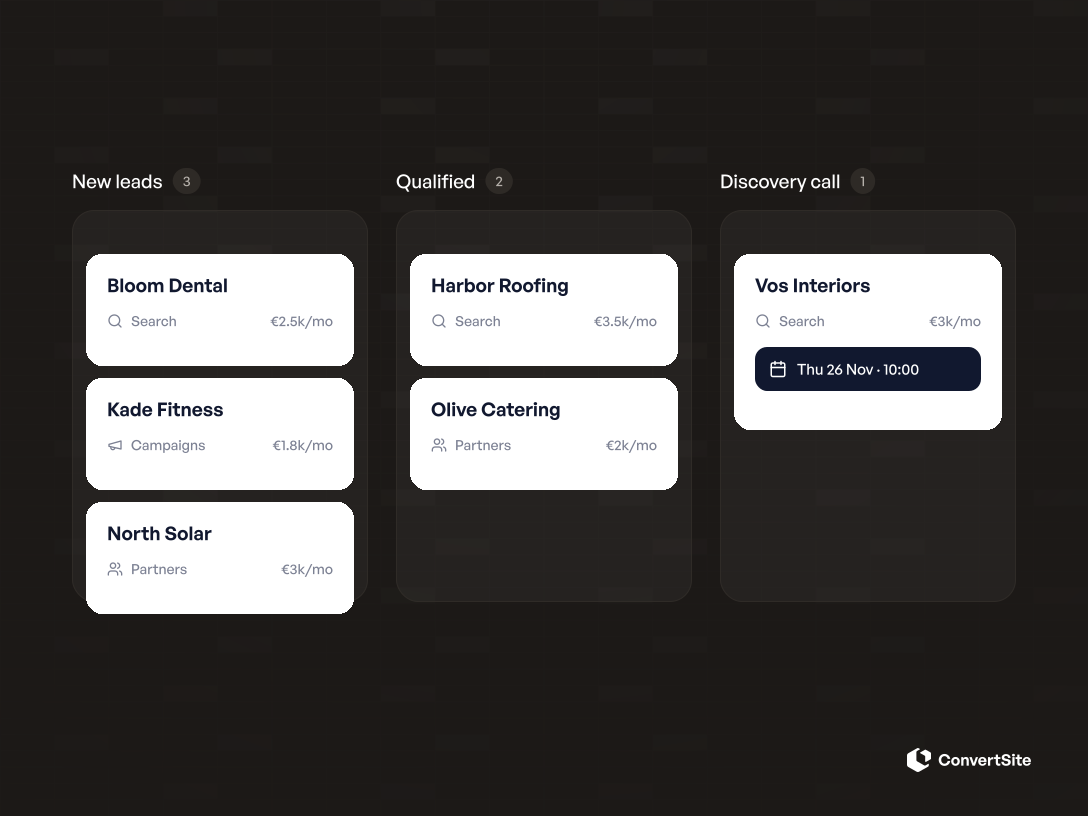
Keep a small record that connects the original source, request, qualification decision, sales conversation, proposal, and outcome. Use the stages your agency actually works through.
Define a qualified lead before comparing channels. For example, the business needs the work you provide, has a viable budget, and can take part in delivering it. A downloaded resource alone does not establish that fit.
Track acquisition cost alongside the work won. Cost per lead is useful, but a low number can hide time spent on unsuitable requests. Include agency time when deciding whether a channel is sustainable.
Allow the same time for each group of leads to progress. A recent campaign and an older referral cohort have had different opportunities to close. Keep unknown sources visible rather than assigning credit you cannot support.
Start the weekly review with the stage that needs attention. No suitable visits suggests a distribution or offer question. Visits without requests suggest a page or next-step question. Relevant calls without proposals suggest a scope or sales question.
Use those observations to choose the next change. The goal is a repeatable way to reach businesses you can help and start conversations your team knows how to handle.
Frequently asked questions answered