








What you'll learn
- What Is a Product Configuration Platform?
- How a Product Configuration Platform Works
- Product Configurator Examples
- Solar Installation Systems:
- Photography Packages:
Businesses with complex quoting face a new reality: buyers expect to personalize, visualize, and price products instantly, whether you sell furniture, equipment, services, or any product with options.
Yet, is your team stuck quoting with spreadsheets, outdated price books, or endless back-and-forth emails?
This slows things down and opens the door to costly errors. Research from McKinsey & Company shows that companies overhauling their quote-to-cash processes can improve speed to contract by 20-40%.
If your products, services, or deals have moving parts, or you’re tired of being boxed in by clunky or expensive configuration tools, read on to learn a smarter way…
What Is a Product Configuration Platform?
A product configuration platform is software that lets you build custom quoting and ordering tools. Customers, or your sales team, use it to personalize products, explore product options, and get accurate, instant pricing directly on your website or sales system.
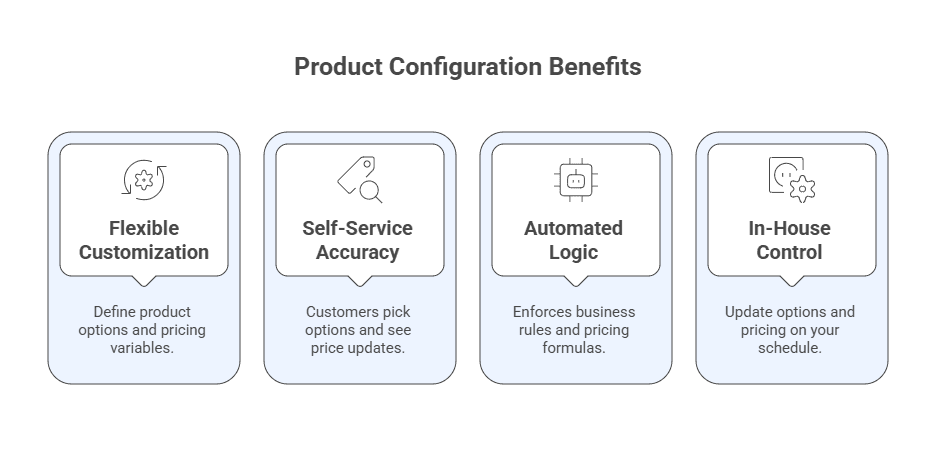
Instead of relying on generic forms, manual spreadsheets, or limited plug-ins, a configuration platform delivers:
-
Flexible Customization: Define all product options, features, and pricing variables to fit your catalog or services.
-
Self-Service Accuracy: Customers or sales reps pick exactly what’s needed, see every price update as they go, and get a precise summary before ordering.
-
Automated Logic: Enforces business rules, pricing formulas, and compatibility automatically, so quotes are fast and correct every time.
-
<strong>In-House Control: </strong>Update options, change pricing, or run promotions on your schedule. No IT tickets or long support queues.
With a product configurator like Convert_, you can handle everything from simple add-ons to complex, bundled configurations and services. This approach automates quoting and helps you avoid costly mistakes as your product offerings grow.
How a Product Configuration Platform Works
A product configuration platform replaces static price sheets and repetitive manual quoting with an interactive system that handles every step of the sales process.
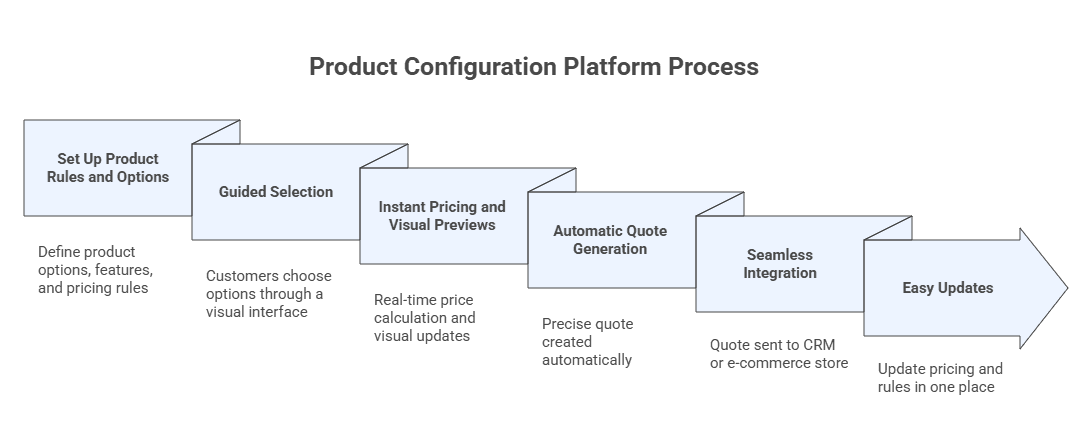
Here’s how it works:
1. Set Up Product Rules and Options: You define every product option, feature, and pricing rule in the platform. This can include sizes, colors, add-ons, custom bundles, volume discounts, or location-based fees.
2. Guided Selection: Customers or your sales team choose the exact options needed through a simple, visual interface. Each selection instantly updates the available choices and overall price.
3. Instant Pricing and Visual Previews: As options are selected, the platform calculates the total price in real time. Some systems also update product images or 3D previews so buyers see what they are getting.
4. Automatic Quote Generation: When all options are selected, a precise quote is automatically created—no manual math, no missing add-ons, no back-and-forth.
5. Integration: The platform can send the quote to your CRM, e-commerce store, or payment system, so orders move forward without duplicate data entry.
6. Easy Updates: When pricing, product offerings, or rules change, you update them once in the platform. New options and prices are live everywhere immediately.
With this setup, you save time, reduce errors, and move from “request for quote” to closed deal much faster.
Here's an example of a customizable t-shirt product configurator:
Screen printing price quote calculator
Product Configurator Examples
Here are some common configurator use cases where configuration drives sales, accuracy, and customer satisfaction:
Custom Furniture: Let buyers choose size, finish, fabric, and accessories. They see an updated price and visual each time they change an option. This transparency helps reduce order errors and boosts buyer confidence.
Modular Homes and Construction: Customers or contractors can build out a tiny home or office project step by step: floor plan, upgrades, finishes, and site delivery. Each choice updates visuals and total cost.
Solar Installation Systems:
Homeowners input their roof specifications, energy usage, and location while the solar configurator calculates panel requirements, system costs, tax incentives, and projected savings. The platform handles complex variables like sun exposure, local regulations, and financing options to deliver accurate quotes instantly.
Photography Packages:
Photographers configure session types, shoot duration, number of edited photos, print packages, and add-ons like albums or canvas prints. Each selection updates pricing and deliverables, making it easy for clients to build their perfect package while the photographer maintains profitable margins.
Do I need a 2D or 3D Product Configurator?
When weighing a 2D versus 3D product configurator, it’s important to consider what delivers value for your business and customers. Sometimes, “flashy” isn’t worth the extra cost.
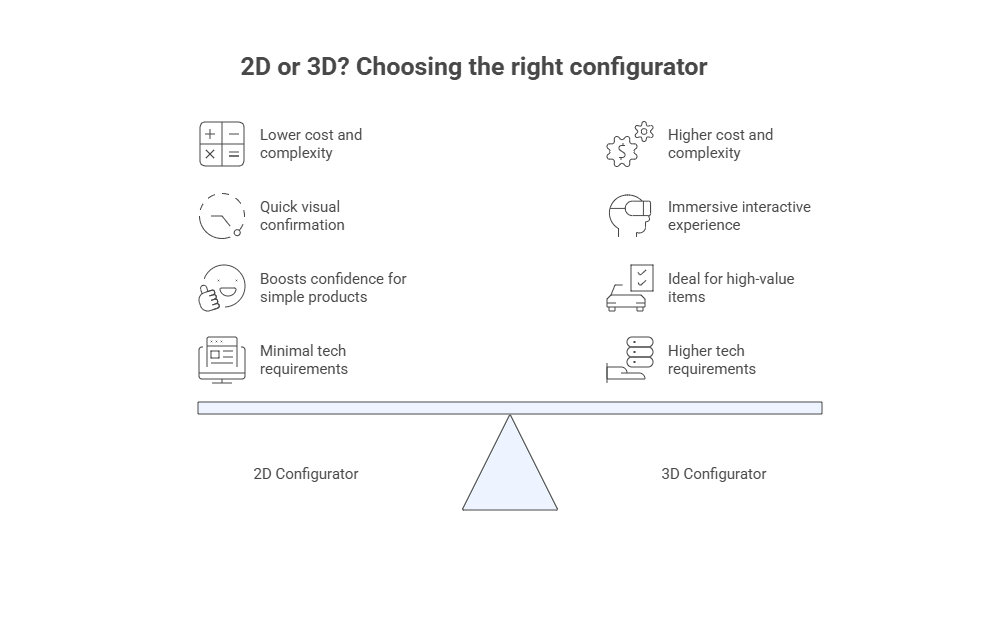
If spatial fit affects purchase confidence, 3D helps; otherwise 2D wins on speed and cost.
<table><tbody><tr><td><p><strong>Feature/Use Case</strong></p></td><td><p><strong>2D Configurator</strong></p></td><td><p><strong>3D Configurator</strong></p></td></tr><tr><td><p>Best For</p></td><td><p>Colors, finishes, flat designs, simple parts</p></td><td><p>Complex shapes, full rotations, spatial fit</p></td></tr><tr><td><p>Setup & Maintenance</p></td><td><p>Fast, easy, lower cost</p></td><td><p>Requires more setup and assets, higher cost</p></td></tr><tr><td><p>Customer Experience</p></td><td><p>Visual confirmation, quick updates</p></td><td><p>Immersive, interactive, can show every angle</p></td></tr><tr><td><p>Sales Impact</p></td><td><p>Boosts confidence for straightforward products</p></td><td><p>Ideal for technical or high-value items</p></td></tr><tr><td><p>Tech Requirements</p></td><td><p>Minimal, web browser friendly</p></td><td><p>Needs more bandwidth, sometimes extra plugins or AR support</p></td></tr><tr><td><p>Mobile Friendly</p></td><td><p>Yes, loads fast on most devices</p></td><td><p>Can be slow or complex on mobile devices</p></td></tr><tr><td><p>Example Industries</p></td><td><p>Apparel, modular kits, basic furniture, gifts</p></td><td><p>Furniture, vehicles, equipment, architecture</p></td></tr><tr><td><p>Pricing</p></td><td><p>Usually lower, scalable for many SKUs</p></td><td><p>Higher, best justified for high-ticket or technical sales</p></td></tr></tbody></table>2D Visuals: Effective and Cost-Friendly
Most businesses don’t need 3D to drive sales. Well-designed 2D configurators provide clear, real-time visuals that show customers exactly what they’re getting, color, style, add-ons, and more.
With layered images and instant previews, users get all the information they need to make confident choices.
For most use cases, like furniture, apparel, bundled kits, modular products, or even construction, the leap to 3D doesn’t increase conversions enough to justify the extra cost of development, asset design, and load times.
3D Tech: Only Worth It for Niche or High-Ticket Sales
3D configurators do look impressive, but they’re expensive. The required software licenses, design labor for every product and variant, higher hosting costs, and more complex integrations add up quickly.
Unless you’re selling products where how something fits in space (e.g., vehicles, custom machinery, or luxury architecture) directly affects the sale, 2D visuals perform just as well and deliver a smoother, more budget-friendly experience for both you and your customers.
Bottom Line: Invest in 2D if you want fast time to market, lower costs, and visuals that help buyers make decisions without all the tech headaches.
Only consider 3D if you have the budget and a clear reason, like selling high-ticket items where buyers truly need to inspect and rotate every angle before buying.
E-Commerce Product Configurator Platform
For online e-commerce stores, offering customization has become an expectation. 80% of consumers prefer brands that offer personalized experiences, and report spending 50% more with them. (Deloitte, 2020).
How E-Commerce Configurators Work
-
Customers explore every option—color, size, style, add-ons—right from the product page.
-
As they make selections, visuals and pricing update instantly, so there’s never any doubt about what they’re getting or how much it costs.
-
When ready, customers can add their custom build straight to the cart and check out—no waiting or manual quoting.
Why a Platform Matters
-
Out-of-the-box plugins may handle a few options, but often break down with even moderate complexity.
-
A true configuration platform lets you manage bundles, compatibility, advanced pricing rules, and even internal logic—all without code.
Business Impact
-
Retailers with robust product configurators see higher conversion rates, larger average order values, and fewer returns.
-
For growing brands, this is a practical way to compete with larger players—delivering a premium experience without a huge dev team.
Beyond Basic Plugins
Many e-commerce platforms offer basic product options, but they hit a wall fast. If you need conditional pricing, bundle logic, or configurations that depend on multiple variables, you'll need a platform built for that complexity.
Tools like Convert_ integrate directly with Shopify and WooCommerce, giving you the power to handle sophisticated product logic while keeping the customer experience smooth.
Product Configuration Platforms for Complex Products
Not all products fit into neat categories or basic dropdown menus. If your business offers bundles, multi-step choices, or anything with “if this, then that” logic, you need a platform that can handle complexity.
What Makes Product Configuration Complex?
-
Conditional Options: Some selections unlock or limit other choices (for example, selecting a certain motor changes what accessories are compatible).
-
Bundled Offers: Customers can build packages with dynamic pricing depending on what’s added or removed.
-
Variable Pricing: Costs can shift based on volume, region, materials, or market changes.
-
Approval Workflows: Some configurations require review or sign-off before they become an order.
Why Simple Solutions Fall Short
-
Basic plugins or forms quickly run out of steam when the logic grows.
-
Manual quoting eats up time and increases the risk of costly mistakes, especially with multiple dependencies or custom rules.
-
As your business expands—new products, changing prices, more options—limited tools become roadblocks instead of solutions.
What a True Platform Delivers
-
Advanced Rules Engine: Built-in logic for bundles, compatibility, and custom pricing—all managed in a simple, no-code interface.
-
Instant Updates: Make changes to logic, pricing, or options across your products without developer delays.
-
Reliable Automation: Every quote is consistent, error-free, and production-ready, even as you add new layers of complexity.
Comparing Product Configuration Platforms
When evaluating product configuration platforms, weighing your needs against common limitations is important. Here’s how popular options stack up for businesses looking for the right balance of cost, flexibility, and control:
<table><tbody><tr><td><p><strong>Feature</strong></p></td><td><p><strong>Enterprise Systems</strong></p></td><td><p><strong>Cheap Plugins</strong></p></td><td><p><strong>Convert_</strong></p></td></tr><tr><td><p>Pricing</p></td><td><p>High upfront and ongoing costs; contracts required</p></td><td><p>Low, but with limited features and add-on charges</p></td><td><p>Affordable, transparent monthly pricing; no lock-in</p></td></tr><tr><td><p>Power & Flexibility</p></td><td><p>Highly flexible, but complex to set up and change</p></td><td><p>Basic options, limited logic, often rigid</p></td><td><p>Advanced rule engine, custom logic, easy to update</p></td></tr><tr><td><p>User Control</p></td><td><p>Requires IT or vendor for changes</p></td><td><p>DIY (basic), but often lacks depth</p></td><td><p>In-house control, no code required for changes</p></td></tr><tr><td><p>Visual Configuration</p></td><td><p>2D/3D visuals, but may require custom dev</p></td><td><p>Rarely supports advanced visuals</p></td><td><p>Supports visuals, including 2D/3D and layered images</p></td></tr><tr><td><p>Integration</p></td><td><p>Deep integration, but setup is time-consuming</p></td><td><p>Limited or manual integration only</p></td><td><p>Out-of-the-box connections to Shopify, Woo, etc.</p></td></tr><tr><td><p>Ease of Use</p></td><td><p>Steep learning curve, training required</p></td><td><p>Simple for basic needs, hard for anything more</p></td><td><p>Intuitive interface for all business users</p></td></tr><tr><td><p>Scalability</p></td><td><p>Scales well, but with added complexity and cost</p></td><td><p>Struggles with growth or complex products</p></td><td><p>Grows with your product catalog, no complexity spike</p></td></tr><tr><td><p>Support</p></td><td><p>Dedicated, but slow/support tickets</p></td><td><p>Minimal or community support</p></td><td><p>Fast, expert help; real people, clear docs</p></td></tr></tbody></table>How to Choose the Right Platform for Your Business
When evaluating product configuration platforms, look for one that matches your complexity needs without overcomplicating simple tasks.
Convert_ takes a different approach than traditional configuration software. Instead of forcing you into rigid product templates, it gives you the building blocks to create the logic your business needs.
Whether you're pricing custom furniture with dozens of variables or building a quote system for modular construction, you control every rule, calculation, and workflow.
The platform works especially well for businesses that:
-
Have outgrown spreadsheets but don't need enterprise-level complexity
-
Need custom pricing logic that standard plugins can't handle
-
Want to iterate quickly without waiting on developers
-
Require tight integration with existing tools like Shopify, WooCommerce, or your CRM
Start simple and add complexity as your catalog grows. The FormulaScript engine handles calculations that would break basic form builders, while the visual interface keeps everything manageable and in-house for non-technical teams.
In Conclusion
Choosing the right product configuration platform means balancing power, flexibility, and affordability. You shouldn’t have to settle for overpriced, hard-to-edit enterprise solutions or basic tools that can’t grow with your business.
With a modern platform like Convert_, you control every option, rule, and price—no code, no bottlenecks, and no surprise costs. Whether you sell online, manage complex sales cycles, or need to update offerings on the fly, you get the speed and confidence to win more deals and deliver a better experience for every customer._
Ready to see what’s possible with your own product catalog?
Try Convert_ free or book a personalized demo to discuss your project.
FAQ
Frequently asked questions answered

Emma Francey
Copywriter @ConvertSite







Use cases
