








What you'll learn
- Which Problem Are You Solving?
- When To Use 3D Configurators
- Automotive customization
- When to Use Logic-First Configurators
- Logic-first configurators typically offer:
For e-commerce store owners and B2B sellers looking to let customers configure products online, visual product configurator software breaks into two camps:
-
3D rendering tools built for photorealistic visualization
-
Logic-first platforms built for complex pricing and workflow automation that include a 2D visual component.
Understanding which problem you're solving determines which tool fits your business. The right tool makes the difference between a tool that converts and one that drains your budget.
This guide helps you choose the best software based on your needs. Let’s go.
Key Takeaways
-
Two types solve different problems. 3D configurators focus on photorealistic rendering and spatial validation. Logic-first configurators focus on pricing accuracy, conditional rules, and backend automation, but can still have a visual component.
-
3D makes sense when visual confidence drives purchases: spatial validation, material accuracy, or AR visualization for high-value products.
-
<strong>Logic-first makes sense for complex operations: </strong>products with conditional rules, dynamic pricing, or multi-step workflows. 2D layered images provide visual feedback while backend logic handles business complexity.
-
<strong>Implementation costs vary significantly. </strong>3D configurators require custom modeling and ongoing designer support. Logic-first configurators launch faster with no-code builders and lower ongoing costs.
Outback Plunge Pools grew 50%+ year-on-year using logic-based configurators with 2D layered images and complex pricing automation.
Which Problem Are You Solving?
Product configurators serve two purposes. Understanding which one matters for your business determines which tool you need.
Visual confidence: Some products merit photorealistic rendering. Exact color matching. Material texture. How the product looks in different lighting. 3D configurators excel here.
Process automation: Some products need complex pricing calculations, compatibility rules, and instant quoting. The visual aspect matters, but backend logic closes deals. Logic-first configurators excel here.
Your bottleneck determines your solution.
When To Use 3D Configurators
3D product configurator software from vendors like Threekit, Zakeke, and Configura delivers photorealistic visualization. For certain products, this capability justifies the investment.
Automotive customization
BMW's 3D configurator lets customers open doors, rotate views, and see how light reflects off the vehicle.
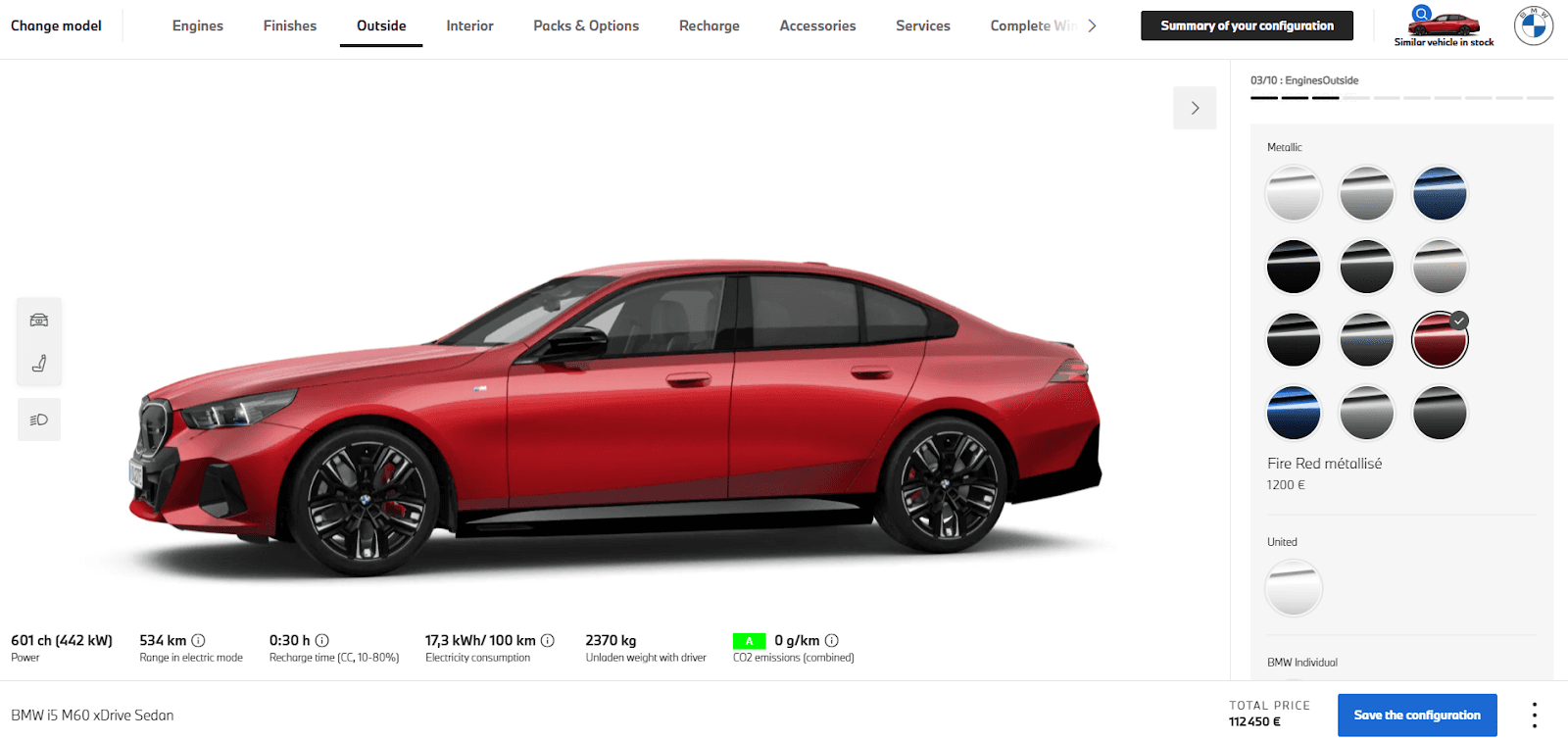
Threekit reports customers achieve 40% higher online conversion rates and 30% improvement in average selling prices when replacing 2D images with 3D.
Industrial equipment and machinery. Dimensional accuracy and spatial validation matter before purchase. 3D models with measurement tools help customers confirm equipment fits their space. When getting the configuration wrong can cost thousands in returns or rework, 3D visualization prevents costly mistakes.
Custom jewelry and technical B2B products. Light reflection, metal finishes, and stone settings need photorealistic rendering for high-value purchases. Technical products where buyers validate compatibility with existing equipment benefit from AR capability.
3D configurators typically require:
-
Custom 3D modeling for product variants
-
Ongoing designer support for updates
-
Pricing starting at $500/month (Threekit) to $29.90/month plus transaction fees (Zakeke)
-
Longer implementation timelines
If visual accuracy is your conversion bottleneck and average order value justifies the investment, 3D works.
When to Use Logic-First Configurators
Logic-first configurators prioritize backend automation while providing visual feedback through 2D layered images.
Complex pricing structures where price changes based on multiple factors. Volume discounts, regional pricing, feature combinations, add-on costs. The configurator calculates accurately in real time.
Conditional product rules where certain options are incompatible. The configurator hides invalid combinations automatically based on business logic.
Multi-step configuration workflows where customers make selections across categories. The flow guides customers through valid choices.
Quote generation and ordering where the configurator generates quotes, accepts payments, and triggers fulfillment workflows. Integration with CRM and business systems drives conversions.
Products where visual changes are straightforward like color swaps, size options, or feature additions. 2D layered images show these changes without 3D rendering overhead.
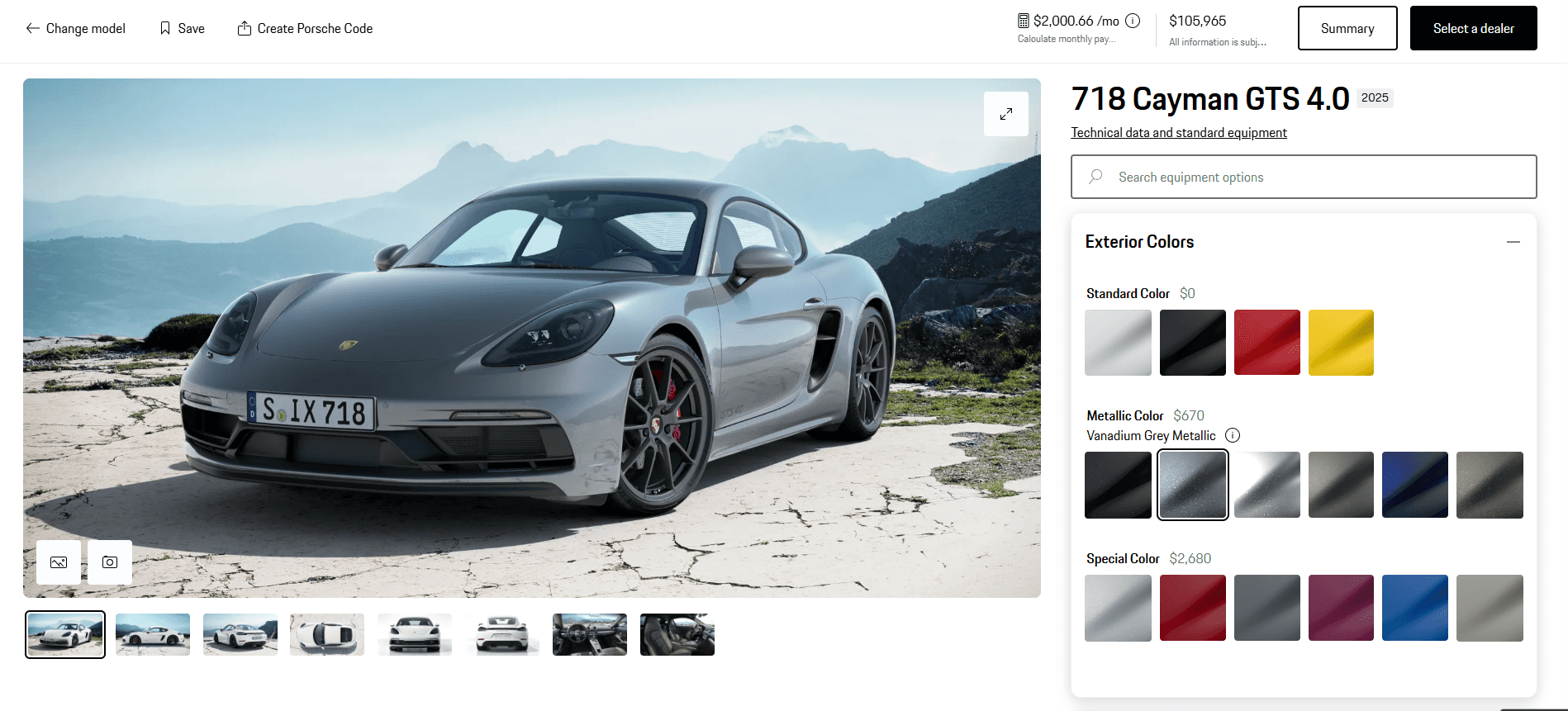
Porsche uses 2D configurators with high-quality renders. Customers explore paint finishes, interior materials, and wheel options while seeing exact color accuracy. The user experience isn’t much different between the two brands, yet the implementation cost would be much higher for BMW.
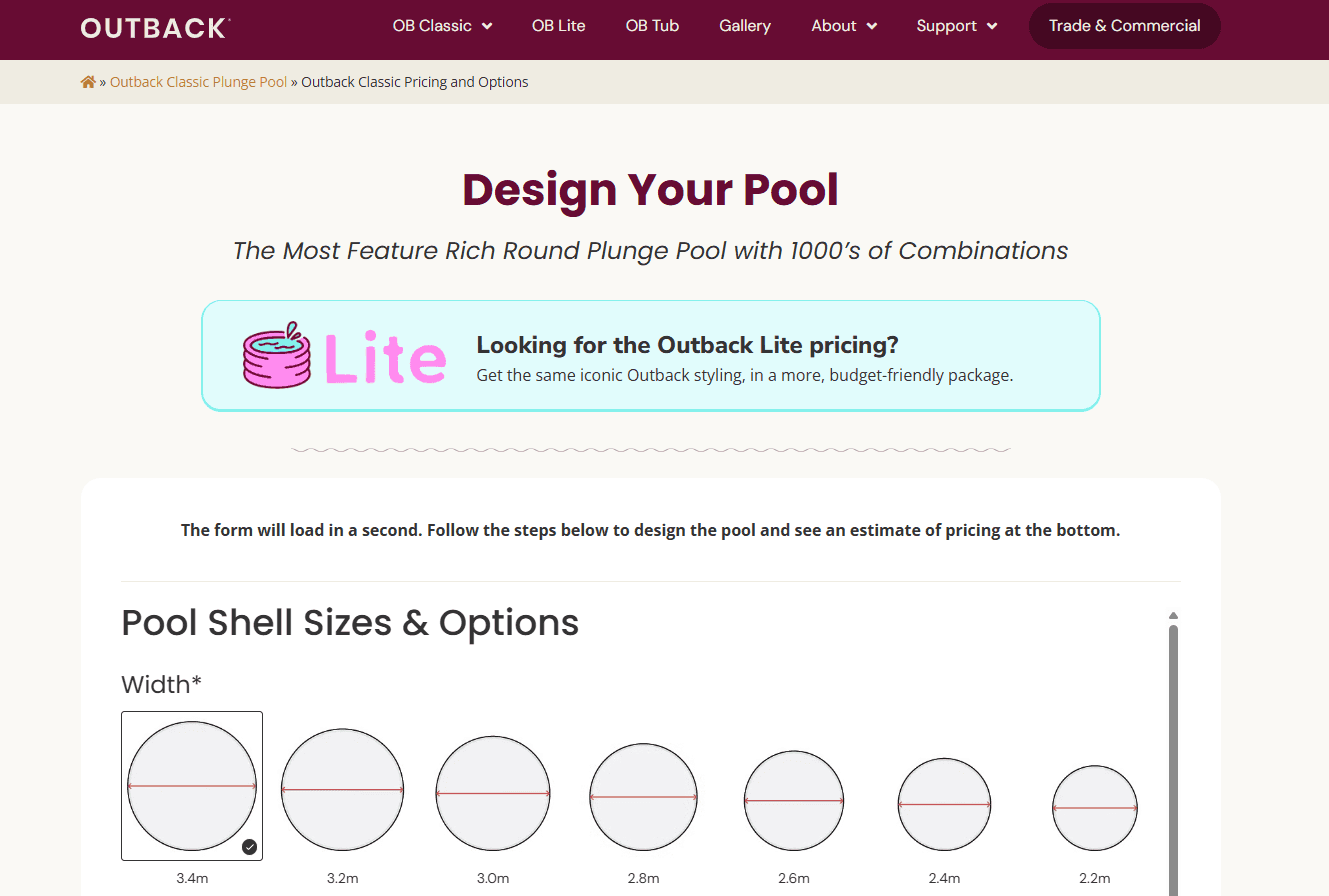
Outback Plunge Pools achieved 50%+ year-on-year growth using a logic-based configurator. Customers configure pool sizes, filtration systems, and installation options while seeing choices reflected through layered images. The configurator handles complex regional pricing and generates instant quotes.
Logic-first configurators typically offer:
-
Fast implementation (hours to days)
-
No-code setup and editing
-
Lower ongoing costs
-
Easy product updates
-
Strong integration capabilities
If your bottleneck is pricing accuracy, workflow automation, or speed to market, this approach fits.
Comparing 3D vs Logic-First Product Configurators
<table><tbody><tr><td><p dir="auto"><strong>Factor</strong></p></td><td><p dir="auto"><strong>3D Visual Configurators</strong></p></td><td><p dir="auto"><strong>Logic-First Configurators</strong></p></td></tr><tr><td><p dir="auto"><strong>Best For</strong></p></td><td><p dir="auto">Photorealistic rendering, spatial validation, material accuracy</p></td><td><p dir="auto">Complex pricing, conditional rules, workflow automation</p></td></tr><tr><td><p dir="auto"><strong>Visual Approach</strong></p></td><td><p dir="auto">3D models with realistic rendering</p></td><td><p dir="auto">2D layered images with instant toggling</p></td></tr><tr><td><p dir="auto"><strong>First Render Speed</strong></p></td><td><p dir="auto"><3 seconds</p></td><td><p dir="auto"><1.5 seconds</p></td></tr><tr><td><p dir="auto"><strong>Performance Load</strong></p></td><td><p dir="auto">Heavier (WebGL/WebGPU, 3D models, textures)</p></td><td><p dir="auto">Light (SVG, images, layered logic)</p></td></tr><tr><td><p dir="auto"><strong>Mobile Accessibility</strong></p></td><td><p dir="auto">Moderate (device-dependent)</p></td><td><p dir="auto">Excellent (low RAM use)</p></td></tr><tr><td><p dir="auto"><strong>Implementation</strong></p></td><td><p dir="auto">Weeks to months</p></td><td><p dir="auto">Days</p></td></tr><tr><td><p dir="auto"><strong>Starting Cost</strong></p></td><td><p dir="auto">$500+/month (Threekit), $29.90/month + fees (Zakeke)</p></td><td><p dir="auto">$0-$200 DIY</p></td></tr><tr><td><p dir="auto"><strong>Updating Products</strong></p></td><td><p dir="auto">Requires 3D designer</p></td><td><p dir="auto">Update yourself</p></td></tr><tr><td><p dir="auto"><strong>Pricing Logic</strong></p></td><td><p dir="auto">Basic or requires development</p></td><td><p dir="auto">Advanced </p></td></tr><tr><td><p dir="auto"><strong>Integration Focus</strong></p></td><td><p dir="auto">Visual/AR experiences</p></td><td><p dir="auto">Payments, CRM, quoting, fulfillment</p></td></tr></tbody></table>How 2D Layered Images Work
2D layered images provide visual feedback for product configurators. Upload images for each product option (colors, features, styles). The configurator toggles images on and off based on customer selections.
Customers see their configuration take shape visually while the backend calculates pricing and enforces rules.
This works when:
-
Visual changes are clear (color, size, features)
-
Photorealistic rendering isn't required
-
Speed matters
-
You update products frequently
Check product configurator examples to see 2D layered images across industries.
Platform-Specific Product Configurator Considerations
Your e-commerce platform affects which configurators work and how they integrate. Here's what matters for Shopify, WooCommerce, and WordPress.
Shopify Product Configurator
Shopify limits products to 100 variants. Both 3D and logic-first configurators work around this by calculating externally. Choose your Shopify product configurator based on whether you need photorealistic rendering or complex pricing automation.
WooCommerce Product Configurator
WooCommerce offers flexibility through plugins or embedded configurators. Building a WooCommerce configurator comes down to whether you need 3D rendering or backend logic capabilities.
WordPress Product Configurator
WordPress sites without e-commerce often need WordPress configurators for lead generation and quoting. Visual presentation matters, but capturing qualified leads with accurate estimates matters more.
How to Choose Between 3D and Logic First
Ask these questions:
What's blocking sales?
-
Customers can't visualize the product accurately → Consider 3D
-
Customers can't get accurate pricing quickly → Logic-first
What's your average order value?
-
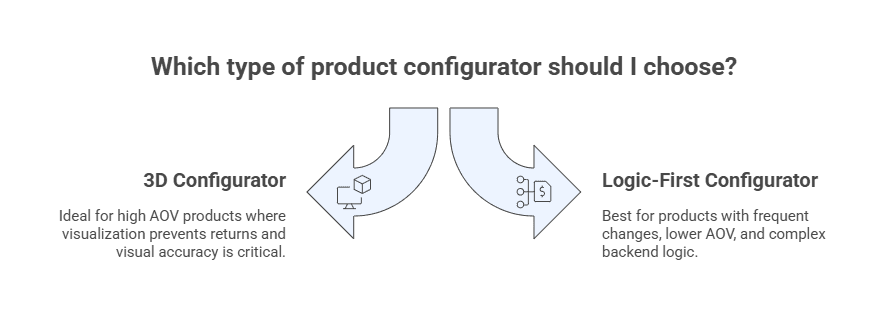
High AOV where visualization prevents returns → 3D worth evaluating
-
Lower AOV or frequent product changes → Logic-first
How often do products or prices change?
-
Rarely, and visual accuracy critical → 3D manageable
-
Frequently → Logic-first allows quicker updates
What's your timeline?
-
Need it live in weeks → Logic-first
-
Can invest months in 3D implementation → Consider 3D if visualization is critical
Do you need complex backend logic?
-
Conditional rules, dynamic pricing, workflow automation → Logic-first
-
Straightforward pricing, focus on visualization → May suit 3D
Building Logic-First Product Configurators
Building a configurator doesn't require months of 3D modeling or custom pricing. Logic-first platforms let you launch with the features you need, update products yourself, and automate your backend workflows.
Convert_ handles product configurator use cases where backend logic and workflow automation matter most.
Layered images for visual product presentation. Upload images for each option. The configurator toggles them based on customer selections. Fast loading. Mobile-friendly. Easy to update.
Conditional logic that automatically hides incompatible options. Set business rules once. The configurator enforces them. No invalid combinations.
Dynamic pricing with formulas as complex as your business needs. Volume discounts, tiered pricing, regional variations, add-on costs. Calculate accurately in real time.
Direct payment processing through Stripe. Customers configure, see their price, and pay immediately.
CRM and workflow integration via native connections or Zapier. Configuration data flows to your sales team, fulfillment system, and customer database automatically.
JSJ Smart Homes cut quoting costs by 97% using Convert_ to automate smart home project quotes. Customers answer questions about lighting, heating, security systems, and automation needs. Conditional logic filters options based on their answers.
The configurator generates instant pricing for complex installations. Stefan, the director, got 30 hours per week back. The sales team saved 32 hours per week. Lead quality increased 100%.
FAQ
Frequently asked questions answered

Emma Francey
Copywriter @ConvertSite







Use cases
